
Family-owned · Bellevue Local
Fence Staining and Sealing
We clean it first, then stain it right, so the color holds and the wood lasts.
Free estimate
Tell us what you need
Three fields. It reaches a person here, not a call centre.
Fence Staining and Sealing That Holds
Fence staining and sealing protects a wood fence from sun, rain and rot: the boards are cleaned first, then coated with a penetrating stain. Frontline Home Services stains fences in Bellevue, Papillion and across the Omaha metro. Fence staining and sealing is a two-step job, not one. Most homeowners who've had a stain peel within a season got hit by the same problem: the contractor skipped the prep. Bare, weathered wood won't hold stain the way clean, dried wood does. At Frontline Home Services, we pressure wash the fence before a single drop of stain goes on. That's not extra. It's the job done correctly. Andy has 5-star reviews across 42 Google customers and a satisfaction guarantee. Call (402) 218-0676 to get a straight answer on what your fence needs.
Cedar fences in Nebraska take a beating. Summer UV, spring moisture, and freeze-thaw cycles in winter pull the gray right out of the wood and leave it cracked and thirsty. Staining restores the color and drives a sealer into the grain that blocks moisture from getting back in. The cost of a fence staining job depends on fence length, height, board condition, and whether it's one or two sides. A fence in good shape that just needs a refresh costs considerably less than one that needs heavy cleaning and partial repairs first. Every job is different, contact Frontline Home Services for an accurate estimate.
Call (402) 218-0676Why the Prep Work Matters More Than the Stain
Skip the cleaning and even the best stain peels within two years.
Our Process
How We Stain a Fence from Start to Finish
Clean and Inspect
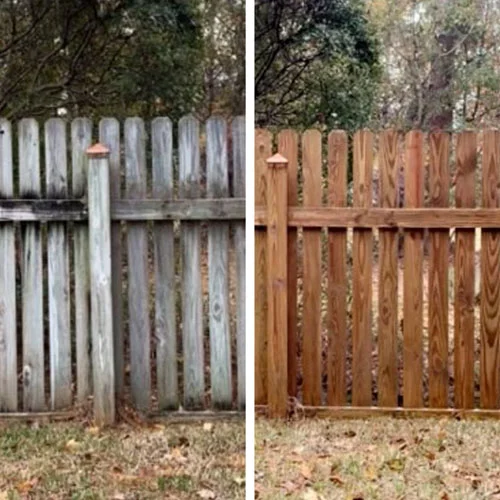
We pressure wash the entire fence to strip mildew, dirt, and gray surface oxidation. Once it's clean, we look at every board and flag anything that needs attention before staining begins.
Dry and Prep
Wood needs to be dry before stain goes on, typically 24 to 48 hours after washing depending on weather. We schedule around this. Rushing the dry time is one of the fastest ways to ruin a stain job.
Apply Stain and Seal
We apply a penetrating stain-sealer that soaks into the grain rather than sitting on top of it. You get UV protection, water resistance, and restored natural color that lasts. We clean up completely before we leave.
What to Know
Cedar, Pine, and Treated Wood: They're Not All the Same
Cedar Fences
Cedar is naturally resistant to rot and takes stain well. It grays out faster than treated wood though. A semi-transparent stain lets the grain show through and slows future graying. Most cedar fences in the Omaha area need restaining every 2 to 3 years.
Pressure-Treated Pine
Treated pine needs more time to dry out before it holds stain properly, sometimes 6 months on a new fence. Staining too early means the chemicals in the wood resist absorption. We'll tell you if your fence needs to wait rather than waste your money.
Old or Weathered Wood
Heavily weathered fences sometimes need a wood brightener applied after washing to open the grain back up. Without it, the wood can be too closed and dense to absorb stain evenly. We assess this during the cleaning stage.
Vinyl Fences
Vinyl doesn't get stained. It gets cleaned. If you've got a vinyl fence that needs to look new again, that's a pressure washing job, not a staining job. We do both and we'll point you to the right service.
What a Good Stain Job Looks Like Three Years Later
When Should You Stain vs. When Should You Replace?
- 01
Stain it: The wood is structurally sound
If the boards are solid, nails are tight, and the gray color is surface-level, staining will restore it and protect it for years.
- 02
Stain it: Water no longer beads on the surface
When water soaks straight into the wood instead of beading, the previous sealer is gone. That's exactly when staining protects the fence from deeper damage.
- 03
Replace it: Boards are soft, spongy, or crumbling
Stain won't fix rot. If you can push your thumb into a board, that board is done. Staining over rot just hides it until the fence falls.
- 04
Replace it: More than 30% of boards are failing
At some point a patch job costs more than a fresh fence. We'll tell you honestly which side of that line you're on. We'd rather lose the staining job than have you unhappy with the result.
Frontline's Satisfaction Guarantee
Veteran-owned. BBB accredited. 42 five-star Google reviews.
- Satisfaction guaranteed on every staining job If it's not right, we come back and make it right. That's the whole deal.
- Andy shows up personally You're not getting a subcontractor. The owner runs the work.
- Available 7 days a week We schedule around your timeline, including weekends.
- No upsells you don't need If your fence only needs cleaning, we'll tell you that. Honest assessment, every time.
Get started
Ready to Restore Your Fence?
Call Andy directly at (402) 218-0676 for a straight answer on what your fence needs and what it'll cost. No runaround, no generic quote, just an honest look at the job.
5.0 from 42 Google reviews